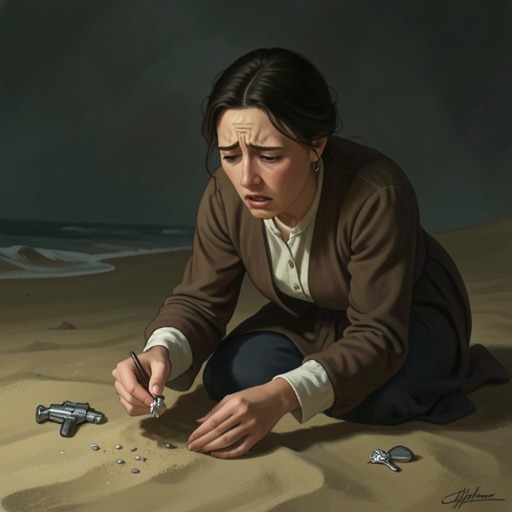
Minta Doyle loses her grandmother’s brooch
To the LighthouseMinta Doyle loses her grandmother’s brooch during a walk along the shore, and the search that follows makes a small, cherished object the center of a larger emotional turning point. As the tide advances, the group’s effort to recover the heirloom gives way to Paul Rayley’s attempt to comfort Minta; at the same time, Nancy recognizes that Minta’s sobbing cannot be explained by the loss alone.
The discovery on the shore
Nancy and Andrew are exploring the shore when Andrew calls that the sea is coming in. Nancy leaps through the shallow waves and runs behind a rock, carried by her eagerness for movement. There she unexpectedly sees Paul and Minta kissing. Outraged, she and Andrew silently put on their shoes and stockings. Their silence soon sharpens into mutual irritation: Andrew resents that Nancy is a woman, and Nancy resents that Andrew is a man. The episode has placed Nancy and Andrew at the edge of Paul and Minta’s intimacy before the missing brooch gives the group another reason to close ranks.
After they have climbed back to the top of the cliff, Minta cries out that her grandmother’s brooch is gone. It is a weeping-willow ornament and the sole piece of jewelry she owns. Her grandmother had used it to fasten her cap until the last day of her life, so Minta insists that she would rather have lost anything else. The brooch is not merely a replaceable possession: its connection to her grandmother makes the loss a rupture in a personal inheritance.
The search and the advancing tide
The group turns back to look for it. They peer along the ground with their heads low, speaking shortly and gruffly, while Paul searches frantically near the rock where he and Minta had been sitting. Andrew privately judges the commotion excessive. Paul asks him to search thoroughly between two points, but the tide is coming in fast and will soon cover the spot. The search is pressed forward by a natural limit that no one’s determination can overcome.
When Minta suddenly cries that they will be cut off, the others treat her fear as another sign that her emotions have outrun the danger. Andrew compares it to an earlier scare with bulls and thinks she has little control over her feelings. Paul and Andrew, meanwhile, become conspicuously manly, briefly confer, and decide to leave Rayley’s stick to mark the place so that they can return at low tide. They assure Minta that, if the brooch is there, it will still be there in the morning. The plan postpones recovery rather than promising it: the sea dictates when they may search again, and Minta continues to sob as they climb away.
Grief beyond the missing heirloom
Nancy suspects that the brooch is not the whole cause of Minta’s tears. Minta says she would rather have lost anything else, and her attachment to the heirloom is real, but Nancy feels that she is also crying for something else. That intuition opens the scene beyond a practical misfortune without identifying a definite hidden cause. Nancy imagines, more broadly, that they might all sit down and cry, while admitting that she does not know what they would be crying for.
The passage holds particular loss beside an unnamed, shared vulnerability. Minta has a specific object and a specific family memory to grieve; Nancy’s response senses a wider sorrow but cannot give it a clear object or explanation. The distinction matters: the narrative acknowledges both the tangible force of the brooch’s absence and the possibility that emotion exceeds what can be accounted for in words.
Paul’s consolation and imagined future
Paul draws ahead with Minta and tries to comfort her by telling her that he is famous for finding things. As a boy, he once found a gold watch. He privately resolves to rise at daybreak and search for the brooch; if he cannot find it, he will go to Edinburgh and buy Minta another, more beautiful one. His promise is an effort to restore what she has lost, but it also reveals his desire to prove his own capability. He imagines the solitary, potentially dangerous dawn search before turning to the possibility of a substitute.
As the two walk close together, Paul imagines what may follow from their relationship: marriage, children, and a house of their own. He also pictures them retreating into solitude together, with himself leading and Minta pressing against his side. These imagined scenes transform the walk from a search for a lost ornament into a projection of shared life. Yet Paul also recalls that asking Minta to marry him was the most appalling experience of his life. The bold future he now pictures had begun in fear and uncertainty.
Paul attributes his newfound confidence to Mrs Ramsay. He believes that she made him feel capable of doing what he wanted and that, throughout the day, her attention had silently encouraged him. He plans to tell her that he has acted because of her belief in him. The episode therefore links his courtship to Mrs Ramsay’s influence: Paul’s attempt to console Minta and imagine a future together is also, in his own account, the outcome of someone else’s faith in him.
Significance and limits of recovery
The brooch’s disappearance brings human intentions into contact with material circumstance. Minta’s grief, Paul’s frantic search, and the group’s decision to mark the spot all depend on a small object that has vanished amid the rocks, while the tide sets the time limit and may conceal the place before they can find it. The episode does not report whether the brooch is recovered. Its immediate outcome is instead a deferred search and Paul’s promise to return at dawn, as the couple move together toward an imagined future.
The object concentrates several kinds of attachment without reducing them to one another: Minta’s memory of her grandmother, Paul’s wish to care for her, and Nancy’s sense that the crying has a reach beyond its stated cause. The scene makes recovery uncertain, but not meaningless. By promising to look again and imagining that he can replace what is lost, Paul turns the search into an expression of hope, even as the incoming sea keeps that hope subject to forces beyond his control.